Best Free Sights In Milan: Piazzas, Facades And Viewpoints
Milan's headline sights split cleanly into what you pay for and what stands in the open air for nothing. This guide covers only the second category: the squares, facades, courtyards, viewpoints and genuinely free venues, plus the two free-day schemes that unlock the paid ones.
Short answer
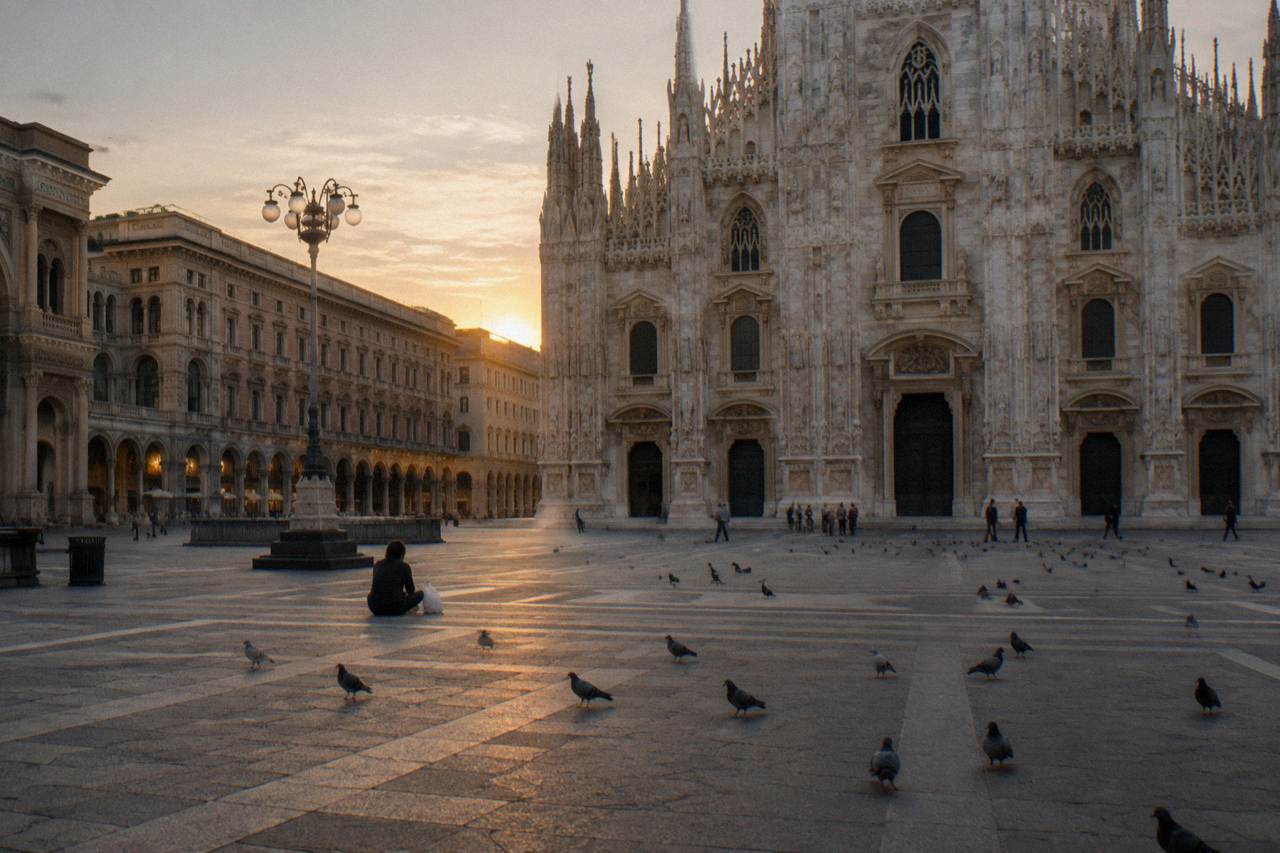
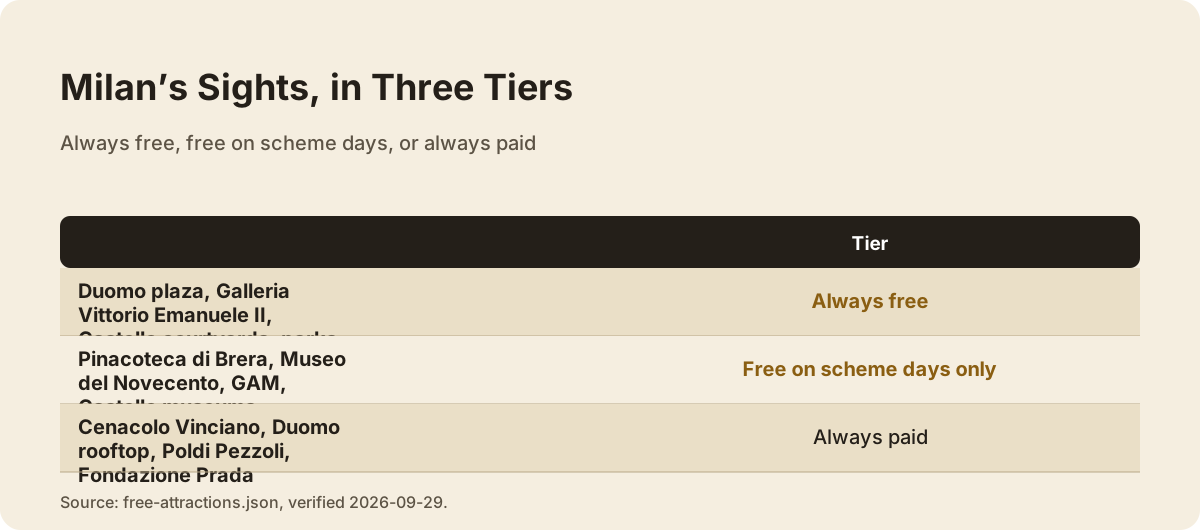
Most of Milan's famous sights cost nothing to see from the outside: Piazza del Duomo, the Galleria Vittorio Emanuele II, Castello Sforzesco's courtyards, Parco Sempione and the Navigli canals are all free public space. Inside, Pirelli HangarBicocca is free with no ticket, and state museums including the Pinacoteca di Brera are free on the first Sunday of the month.
Milan rewards looking up. The city's most photographed sights, the marble face of the Duomo, the glass vault of the Galleria, the brick towers of the Castello Sforzesco, are all visible from public ground that never charges admission. The paid part of Milan is mostly indoors: museum galleries, cathedral interiors, rooftop terraces. If you plan your day around what stands in the open, you can see the city's entire skyline of landmarks without buying a single ticket.
This guide is the sights companion to the site's broader activities coverage. It sticks to what you can see for free: squares, facades, monuments, viewpoints, and the handful of venues that genuinely open their doors at no charge. Where a sight is only conditionally free, the condition is stated in the same breath, because Milan has a few famous traps where "free" is true only one Sunday a month, and only with a reservation.
What Can You See In Milan For Free?
The short answer is: nearly every famous exterior in the city. Piazza del Duomo, the Galleria Vittorio Emanuele II, the Castello Sforzesco courtyards, Parco Sempione, the Arco della Pace, the Colonne di San Lorenzo, the Navigli canals and the Bosco Verticale are all free public space, open without a ticket. Paid admission starts only when you step inside: the Duomo's interior, the castle's museums, and most galleries charge.
That split, outside free, inside paid, is the single most useful thing to understand about sightseeing in Milan. A first-time visitor who knows it can build a full day around facades, squares and courtyards and spend nothing. The same visitor who does not know it can arrive at the Duomo expecting free entry to the cathedral and discover that tourist access to the interior is a paid ticket, with separate, higher prices for the rooftop terraces.
One exception deserves its own headline. Pirelli HangarBicocca, a major contemporary art space in an converted industrial hangar in the Bicocca district, admits everyone free with no ticket at all, an unusually generous policy for a venue of its scale, and one worth re-confirming on the venue's own site before a long trip out to it. The rest of Milan's free indoor art comes from two monthly schemes, covered later in this guide, which unlock the state and civic museums on set days.
Here is the full lay of the land, sight by sight, before we go deeper on each area.
| Sight | What you see for free | What costs money |
|---|---|---|
| Piazza del Duomo | The square, the cathedral facade, Palazzo Reale's exterior | Duomo interior, rooftop terraces, Duomo Museum |
| Galleria Vittorio Emanuele II | The entire glass-vaulted passage and its mosaic floor | Nothing, it is public space |
| Castello Sforzesco | Courtyards, grounds, facade, fountain square | The civic museums inside the castle |
| Parco Sempione and Arco della Pace | The park, the arch, castle views | Nothing |
| Colonne di San Lorenzo | Roman columns and the square around them | Nothing |
| Navigli and the Darsena | Canals, Vicolo dei Lavandai, the dock basin | Nothing |
| Bosco Verticale and Piazza Gae Aulenti | The towers and the modern Porta Nuova quarter from outside | Nothing, they are exteriors of private buildings |
| Pirelli HangarBicocca | The entire art venue, no ticket needed | Nothing |
Which Piazzas And Landmarks Should You See First?
Start at Piazza del Duomo, then walk through the Galleria Vittorio Emanuele II to Piazza della Scala, a fifteen-minute arc that packs Milan's three signature facades into one free stretch. Add Piazza Mercanti, the medieval square tucked behind the Duomo's flank, and you have covered the historic core. All four are public space, open at all hours, and cost nothing.
Piazza del Duomo is the obvious first stop and it earns the cliché. The cathedral's marble facade fills the eastern side of the square, and the view from the open ground in front of it is the one every visitor photographs. The square itself is free public space, confirmed as standard, and it doubles as the meeting point for several of the city's pay-what-you-want walking tours, including the 2H45 Wonders Walk, rated 4.9 out of 5 across 2,916 GuruWalk reviews, which starts at Piazza del Duomo 6 and runs two hours and 45 minutes in English or Spanish. A guided route is one way to make the facades mean something; standing in the square on your own costs exactly the same.
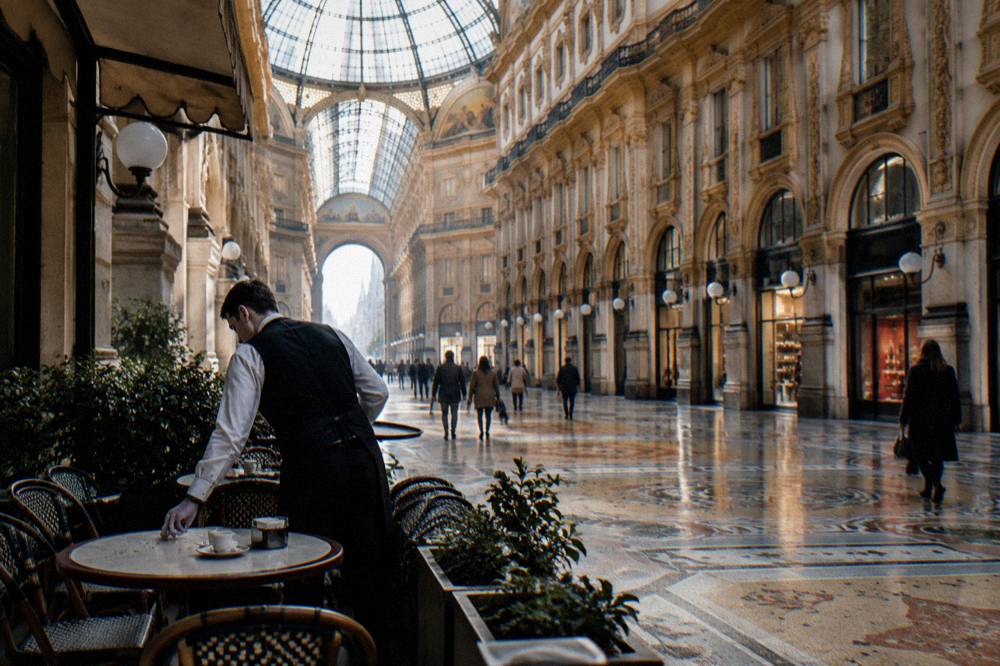
The Galleria Vittorio Emanuele II connects Piazza del Duomo to Piazza della Scala, and walking through it is free. The glass-domed cross vault, the mosaic floors and the famous bull mosaic are all in a public passage, though the shops and cafes lining it are anything but free. Piazza Mercanti sits a short walk west of the Duomo and is the city's medieval civic heart, a small, quiet square most visitors walk straight past. It also happens to be the meeting point for the Coffee Culture Highlights Walk, rated 4.91 out of 5 across 565 GuruWalk reviews, which gathers at Piazza dei Mercanti at the Loggia degli Osii under a pink umbrella.
If you would rather have the route explained than puzzle it out from a map, the pay-what-you-want walks above all pass through this cluster. The Morning and Afternoon Walk, rated 4.5 out of 5 across 273 GuruWalk reviews, covers the same core in a shorter ninety-minute loop from Via delle Ore, which suits travellers with only a half day in the centre.
Is The Duomo Area Free To See?
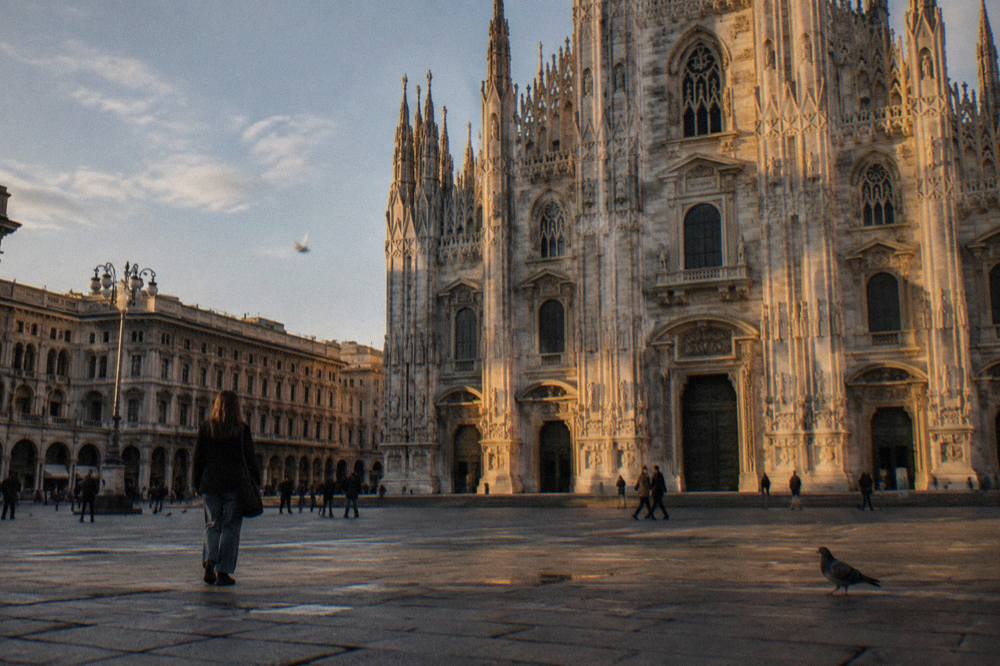
Yes, the outside of the Duomo and the whole square around it are free, but going inside is different. Tourist entry to the cathedral interior and the Duomo Museum is a paid ticket, the rooftop terraces cost more, with stairs cheaper than the lift, and only a prayer-only access mode is free. The facade, the spires and the square cost nothing at any hour.
This is the sight where the free and paid products get conflated most often, and the cathedral's own access rules distinguish three genuinely different things. The first is the square and the facade, free, always. The second is tourist entry to the interior plus the Duomo Museum, a paid ticket that varies by day, with the Museum closed on Wednesdays. The third is the rooftop terraces, priced separately and higher, with a stairs option and a more expensive lift option, and combined tickets that bundle interior, museum and terrace. The cathedral publishes its current prices and access rules on its official site, and that is the page to check before a visit, since this is the single most traffic-heavy fact on any Milan planning list.
There is also a free-museum-day wrinkle specific to the Duomo complex: the Duomo Museum has free days on the last Sunday of the month starting from late September 2026, with a reservation required. That is a separate scheme from the national first-Sunday one, and it applies to the museum, not the terraces.
For the free experience, the move is simple. Walk the square, stand close to the facade's lower detail, and then follow the flank of the cathedral around to the south side, where the view down Via Arcivescovado gives you the spires against the sky without a single ticket. The Express Walk, Official Guide, rated 4.46 out of 5 across 973 GuruWalk reviews, is a ninety-minute English walk that meets at Largo Ildefonso Schuster, a short walk from the Duomo, and is built exactly for visitors who want the core sights explained fast before moving on.
Can You See Castello Sforzesco And Parco Sempione For Free?
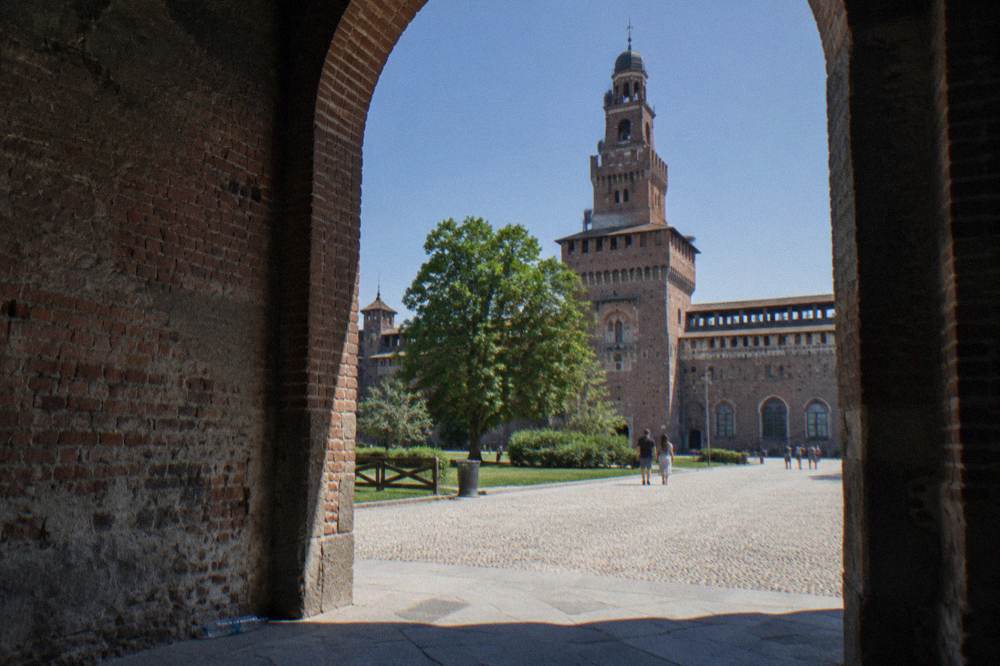
Yes, and this is one of Milan's best free sightseeing combinations. The Castello Sforzesco's courtyards, grounds and facade are free and open daily, while the civic museums inside the castle are paid, free to everyone on the first Sunday of the month and free to under-25s on the second Tuesday. Parco Sempione behind the castle and the Arco della Pace beyond it are free public parkland.
The castle is the clearest example of the outside-free, inside-paid rule. The outer courtyards and grounds, including the fountain square in front of the main entrance and the long courtyard axis running through to Parco Sempione, are free and open daily from early morning to early evening. You can walk the whole exterior circuit, see the tower, the ramparts and the Sempione gate, and never encounter a ticket desk. The museums inside, the castle's art and archaeology collections, are civic museums under the Comune di Milano's ticketing policy, which charges full admission on ordinary days and opens free on the first Sunday of the month for everyone, plus the second Tuesday of the month for visitors up to 25. The Comune publishes the full policy on its official ticketing pages, and the castle's own site carries the current hours and prices.
Parco Sempione is the park that stretches from the castle's back gate to the Arco della Pace, and both are free. The view back toward the castle's towers from the park's central bridge is one of the best free photo angles in the city, and the Arco della Pace at the far end is a triumphal arch you can walk under at no charge. The 2H30 Monumental Walk, rated 4.77 out of 5 across 303 GuruWalk reviews, is the pay-what-you-want walk that covers this monumental axis in English or Spanish, meeting on Via Croce Rossa near the castle quarter.
For a deeper look at the park itself, including its free corners and the castle-view angles, the site's dedicated guide to Parco Sempione and the Sforza Castle views covers it in full, and the blog post Is Sforza Castle Free? answers the interior question in detail.
What Churches Can You See In Milan For Free?
Several of Milan's most spectacular interiors are free to enter as working churches. San Maurizio al Monastero Maggiore, nicknamed the Sistine Chapel of Milan for its wall-to-wall frescoes, Sant'Ambrogio, Santa Maria presso San Satiro with Bramante's famous optical illusion, and the church of Santa Maria delle Grazie are all free. The Last Supper in the refectory next door to Santa Maria delle Grazie is a separate, paid, reservation-mandatory attraction.
San Maurizio al Monastero Maggiore is the standout. Its interior is covered almost entirely in frescoes, and entry to the church is free. Santa Maria presso San Satiro is small and easy to miss near the Duomo, but its choir is Bramante's trompe l'oeil masterpiece, a painted perspective that makes a shallow recess read as a deep apse. Sant'Ambrogio, one of the oldest churches in the city, is free to enter as a working church, though any museum or crypt areas inside may charge separately under standard church rules. Other pages covering the same trip are gathered on Free Things To Do In Milan.
The Santa Maria delle Grazie situation needs care, because two different experiences share one address. The church itself is free to enter during normal church hours. The Cenacolo Vinciano, Leonardo's Last Supper, is in the refectory attached to the church, is state-run, and requires a paid, timed reservation on ordinary days. On the first Sunday of the month it falls under the national Domenica al Museo scheme and is free, but a timed reservation is still required even on the free day; it is never a walk-up free sight. The official reservation channel lists the full entry conditions, and the site's dedicated guide to the Last Supper in Milan walks through the booking mechanics step by step.
| Church | Free to enter? | What stands out |
|---|---|---|
| San Maurizio al Monastero Maggiore | Yes, church access is free | Frescoed interior known as the Sistine Chapel of Milan |
| Santa Maria presso San Satiro | Yes | Bramante's trompe l'oeil choir |
| Basilica di Sant'Ambrogio | Yes, as a working church | One of Milan's oldest basilicas; paid parts may exist inside |
| Santa Maria delle Grazie (church) | Yes, during church hours | Renaissance church, free as a place of worship |
| Cenacolo Vinciano (Last Supper) | No, paid with mandatory reservation | Free only on the first Sunday, and still only with a booked slot |
Which Viewpoints And Skyline Sights Are Free?
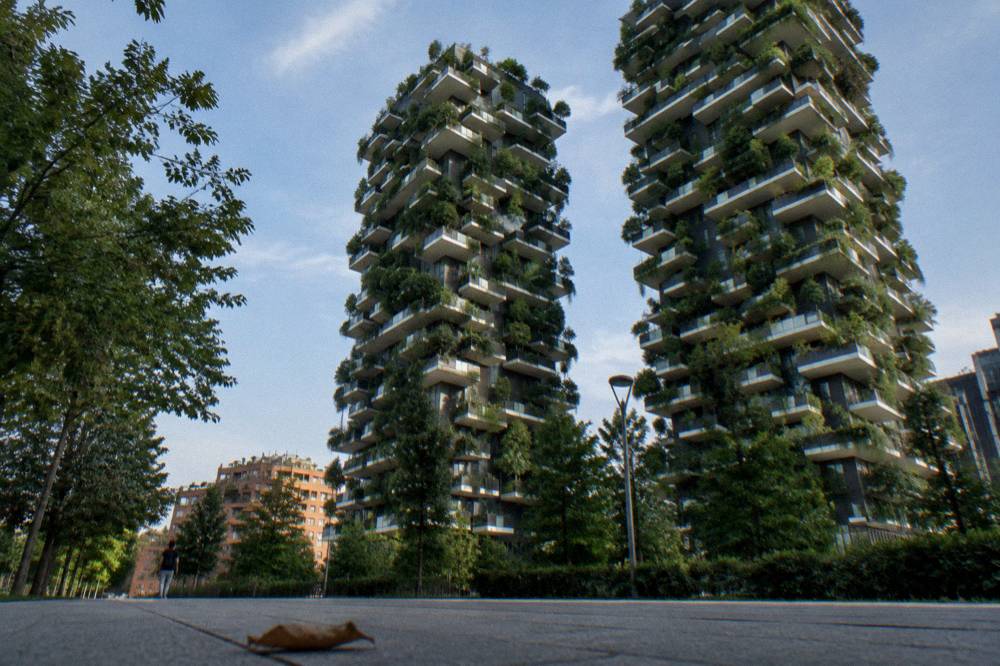
The Bosco Verticale towers, Piazza Gae Aulenti, the Biblioteca degli Alberi park and the whole Porta Nuova skyline are free to see from outside, as is the Monte Stella hill in San Siro. None of these has a ticketed viewpoint; Milan's skyline sights are all public space, viewed from streets, squares and parks. The Bosco Verticale are residential buildings, so the free experience is the exterior, not the upper floors.
Porta Nuova is Milan's modern skyline quarter and it costs nothing to wander. Piazza Gae Aulenti is a raised circular plaza ringed by glass towers, the Biblioteca degli Alberi is the park beside it, and the Bosco Verticale, the pair of tree-covered residential towers, are seen from the surrounding streets. The towers are private homes, so there is no free observation deck; the free sight is the facade itself, hundreds of trees growing off the balconies, best viewed from the park below.
Monte Stella, the artificial hill in the west of the city known locally as the Montagnetta di San Siro, is a free public park with a grassy summit that gives one of the few elevated views over the city available without a ticket. It is a local spot rather than a tourist one, which means quiet paths and very little in the way of crowds. The Isola district beside Porta Nuova rounds out the free quarter, and the site's Isola neighbourhood guide covers its street-level sights in detail.
What Free Art Can You See In Milan Without A Ticket?
Pirelli HangarBicocca is the headline answer: free admission, no ticket, for a major international contemporary art programme. Beyond it, Milan's paid museums unlock on two separate monthly schemes: the national Domenica al Museo opens state museums including the Pinacoteca di Brera free on the first Sunday, and the civic scheme opens museums like the Castello Sforzesco collections and the Museo del Novecento free on the first Sunday too, plus the second Tuesday for under-25s.
Pirelli HangarBicocca, in the Bicocca district, states plainly on its own site that admission is free, and it is the one large contemporary art venue in Milan where no ticket is needed at all. Booking a time slot online is recommended in busy periods, but the venue registers visitors on site otherwise. For a city where the Pinacoteca di Brera charges a full-price ticket on ordinary days, a free hangar of large-scale installations is a genuinely rare thing, and the venue's own contacts page is the place to confirm the policy before travelling out to it.
The two schemes need to be kept separate, because they cover different museums and travellers constantly blur them. The national Domenica al Museo, run by the Ministry of Culture, opens state-run museums free on the first Sunday of the month; in Milan that means the Pinacoteca di Brera, where the free day requires a mandatory reservation through the gallery's booking channel, and the Cenacolo Vinciano with its own reservation trap. Milan's civic scheme covers the city-run museums, the Castello Sforzesco collections, the Museo del Novecento, the GAM and others, and mirrors the first-Sunday free day while adding a second-Tuesday free day for visitors up to 25. Private museums, the Poldi Pezzoli, Fondazione Prada, Armani Silos and Villa Necchi Campiglio among them, set their own independent rules and should never be assumed to follow either scheme, though Armani Silos does participate in the first-Sunday free day with its own conditions. The Comune's official ticketing pages carry the civic scheme in full.
Which Free Districts Are Worth Walking Through?
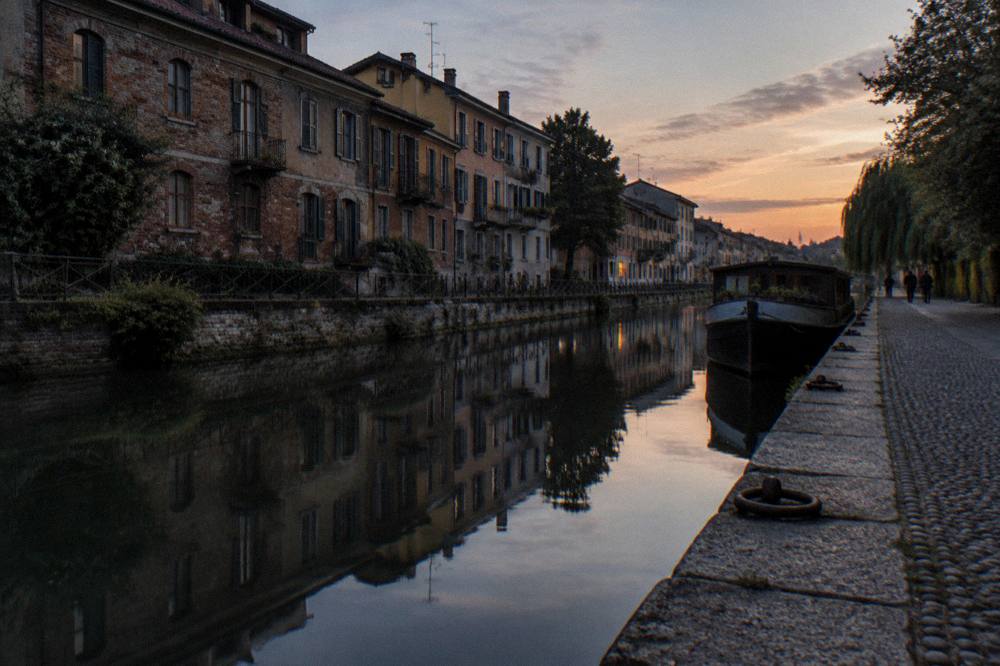
The Navigli canal district, the Colonne di San Lorenzo, the Isola quarter and Via Paolo Sarpi's Chinatown are all free public streets, and together they cover Milan's most atmospheric walking ground. The Navigli's canals and the Darsena dock are free at all hours, the Roman columns at San Lorenzo are an open-air monument, and none of these districts has any gate or ticket.
The Navigli is the classic evening walk: the Naviglio Grande canal, the Vicolo dei Lavandai alley with its old washing shelter, and the Darsena, the dock basin where the canals meet. All of it is public space. The site's Navigli free canal district guide covers the full route and the aperitivo culture that goes with it. The Colonne di San Lorenzo, a row of Roman columns standing in front of the basilica, is one of the city's oldest free sights and doubles as a nighttime gathering spot, which the site's free things to do in Milan at night guide puts in context.
Via Paolo Sarpi, Milan's Chinatown, is a free street in the most literal sense, a busy commercial strip running northwest from the centre, and the site's Chinatown free things to do guide covers what to see along it. The 1H45 Best-Tips Walk, rated 9.4 out of 10 across 562 freetour.com reviews, is the pay-what-you-want walk that covers the city's less obvious corners in English or German, meeting at Palazzo Morando on Via Sant'Andrea, itself a palazzo whose permanent collections are free under the civic scheme.
| District | Free sights | Best time to walk it |
|---|---|---|
| Navigli and Darsena | Naviglio Grande, Vicolo dei Lavandai, the dock basin | Evening, when the canal banks fill up |
| Colonne di San Lorenzo | Roman columns, the square, the basilica exterior | Late afternoon into sunset |
| Isola | Street-level Porta Nuova quarter, independent shops and murals | Daytime, paired with Bosco Verticale |
| Via Paolo Sarpi | Chinatown's street life and food shops | Late morning or early evening |
| Cimitero Monumentale | One of Europe's great cemetery-monuments, free entry | Daytime, in daylight hours |
One more entry belongs in any sights list: the Cimitero Monumentale, Milan's monumental cemetery, which is free to enter and ranks among the most extraordinary open-air sculpture collections in Europe, a point the site's blog post Is Cimitero Monumentale Free? covers in full.
How Do You Fit The Free Sights Into One Day?
The free sights chain naturally into a single walking day: Piazza del Duomo and the Galleria in the morning, the cathedral's exterior and Piazza Mercanti before noon, the castle courtyards and Parco Sempione in the afternoon, and the Colonne di San Lorenzo and the Navigli at dusk. The whole route is on foot, costs nothing in admission, and crosses about six kilometres of public space.
The order matters less than the geometry. The Duomo cluster, the Galleria and Piazza Mercanti sit within five minutes of one another; the castle is a fifteen-minute walk up Via Dante from the Duomo; Parco Sempione flows directly out of the castle's back gate; and the Colonne di San Lorenzo and the Navigli lie to the southwest, best reached on foot in about half an hour or by a short hop on the metro. A traveller who does the centre in the morning, the castle and park after lunch, and the canals at sunset has seen the majority of this guide without spending a euro.
For anyone short on time or preferring company, the pay-what-you-want walks below compress the same ground into guided routes. The 1H30 On-Foot Walk, rated 4.93 out of 5 across 40 GuruWalk reviews, covers the core in ninety minutes from Largo Ildefonso Schuster, and the Travelers' Choice Walk, rated 4.52 out of 5 across 54 GuruWalk reviews, runs a two-hour English loop from the Manzoni monument. The site's free one day Milan itinerary builds the full unguided version hour by hour.
Common Questions About Free Sights In Milan
Is The Duomo Free To See From Outside?
Yes. Piazza del Duomo and the view of the cathedral's facade are free public space at all hours. Tourist entry to the interior and the Duomo Museum is a paid ticket, and the rooftop terraces are priced separately, with the stairs option cheaper than the lift.
Is The Last Supper Free On The First Sunday Of The Month?
It is free that day under the national Domenica al Museo scheme, but a timed reservation is still required even on the free day, and slots are limited. On every other day it is a paid, reservation-mandatory attraction. The church of Santa Maria delle Grazie next door is a separate, free experience during normal church hours.
Are The Castello Sforzesco Museums Free?
The castle's courtyards and grounds are free and open daily. The civic museums inside are paid on ordinary days, free to everyone on the first Sunday of the month, and free to visitors up to 25 on the second Tuesday of the month under the Comune di Milano's civic scheme.
What Is The Best Free Viewpoint In Milan?
For skyline views, the streets and park around the Bosco Verticale in Porta Nuova are the free pick, viewed from Piazza Gae Aulenti and the Biblioteca degli Alberi. For an elevated view, Monte Stella, the artificial hill in San Siro, is a free public park with a grassy summit over the city.
Is Any Major Art Museum In Milan Free Every Day?
Yes, Pirelli HangarBicocca. The contemporary art venue states on its own site that admission is free with no ticket, which is unusual for a space of its scale; booking a time slot online is recommended during busy periods.
Can You See The Galleria Vittorio Emanuele II For Free?
Yes, entirely. It is a public passage connecting Piazza del Duomo to Piazza della Scala, and the glass vault, the mosaic floors and the famous bull are all free to see. Only the shops and cafes inside charge.